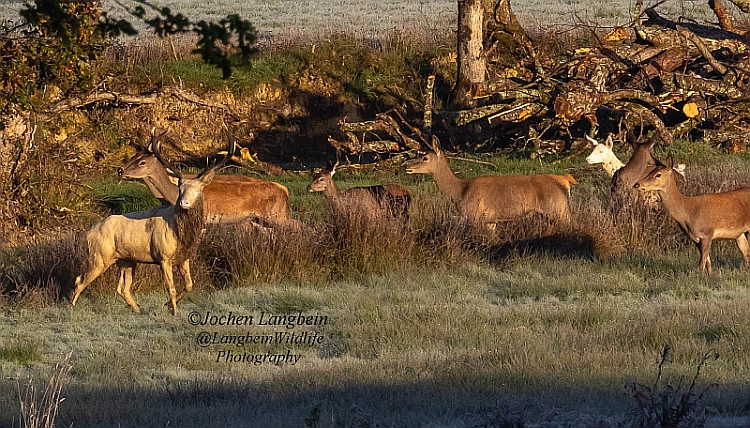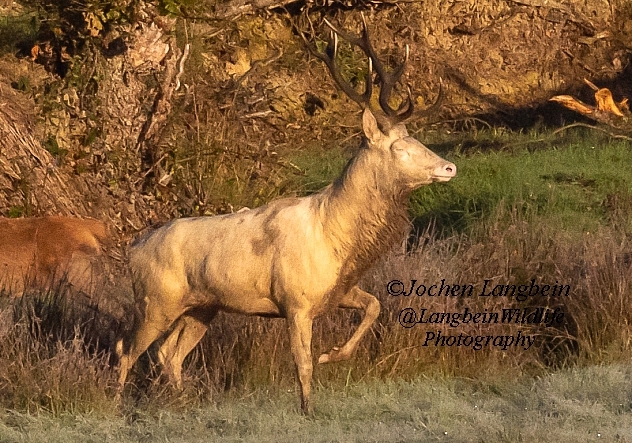
True Albino Deer are extremely rare, especially so in wild ‘Red Deer’ (Cervus elaphus), making up fewer than 0.005 % (<1 in 20,000) of births. Nevertheless, over the past five to ten years in the UK there have been increasing numbers of white ‘red’ deer sightings in the wild. Many but not all of these have occurred in the county of Devon; some as far west as its boundary with Cornwall, others spread throughout much of the county including 75 miles east to the Blackdown Hills on the Devon – Somerset border.
In Fallow deer (Dama dama) white (non-albino) fur colouration is a frequently occurring variant (>10% of individuals in some wild herds). For red deer, however, leucism (partial loss of pigmentation, with white fur but normal colour eyes, eyelids and nose), is also very infrequent even if not quite as rare as albinism.
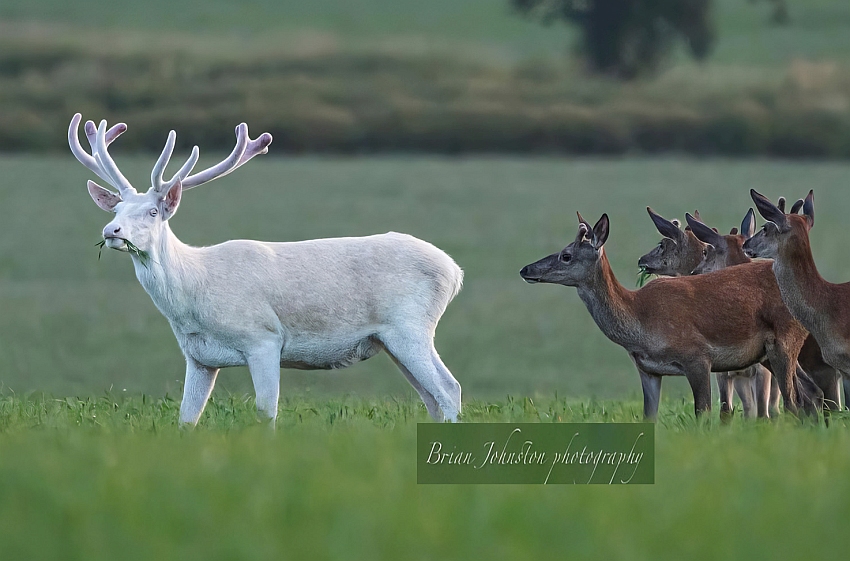
Having followed with interest the increase in white deer sightings via ‘The Deer Year’ facebook group I oversee, I had long been meaning to try and take a closer look at some of the white deer for myself. At the peak of the red deer rut in mid-October I was fortunate to be able to join fellow wildlife photographers Brian Johnston and Will Cory on an outing to try to observe one of the ‘White Harts’ (Hart is a term generally reserved for male red deer) they had been following for some time.
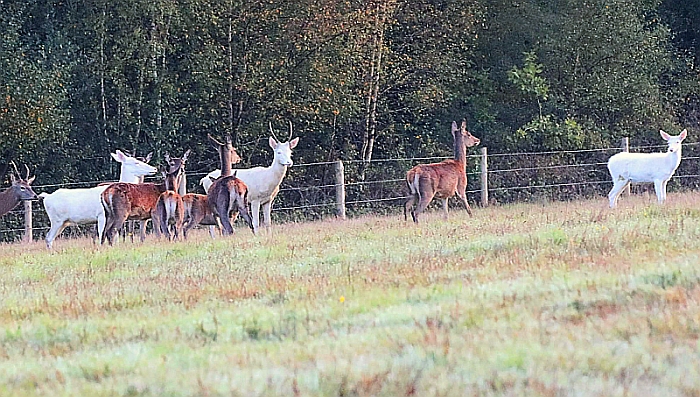
We had arranged to meet before sunrise, on what turned out to be the coldest night of the year so far, with a sharp frost at dawn and a frozen windscreen for my 5 am journey into Devon. Fortunately, it was sufficiently cold and a light breeze to keep away the dense mist that I’d feared might spoil the outing. Having parked up for the start of our photo-stalk, I was amazed to spot a couple of specks of white female deer in the distance – among a herd of normal-coloured ones – whilst there was barely any daylight. For full video of our photo-outing see the Youtube clip below : (for higher resolution or large screen click ‘watch in YouTube’ icon).
Suffice it to say (let the video above speak for itself 😊 ) it turned out to be an incredible morning with stunning sunlight during golden hour, and we were fortunate to observe several white deer, including not least a rutting stag : The White Hart.
One downside of the morning was that the pure white stag that we saw, had been rolling in a mud wallow , to adorn himself with the pungent musky scent for the rut. (see link for more clips on ‘Red deer wallowing’). This made it more difficult to be 100% certain that the stag is a true albino, both he and the white hind and calf did clearly have pink noses and surrounds of the eyes (See images below; and also Brian’s image ‘white stag in velvet’ above, that perhaps best shows the light eye colouring associated with albinism)
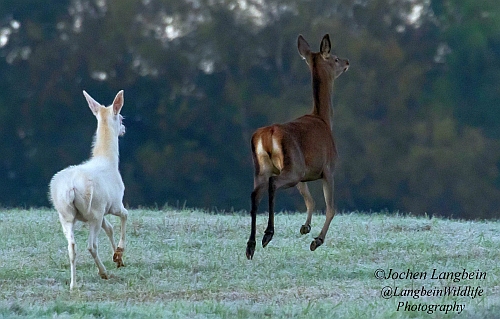
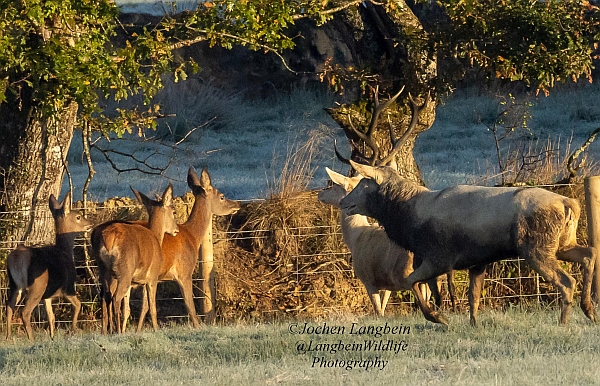
Given the numbers of white deer seen in the herd, and the fact that for a second year a ‘different’ white stag was dominating the rut locally, the continuation of the white gene seems assured for now, even if it may dwindle over time. Based on the work of ungulate biologist Ludek Bartos from the Czech Republic in the 1980s, the gene for albinism in red deer is recessive and controlled by three allelic pairs. This means provided both parents do carry the recessive gene (even if not exhibiting white fur themselves), this will give a chance of about a 25% of progeny being white (as the gene of red colouration remains dominant). Will and Brian did indeed report seeing a red coloured hind that had a white calf. And aside from the stag at the rut this year, a white spiker (yearling red) has also been photographed not far away this year.
The origin of the white wild deer in Devon remains a little unclear. Piecing together bits of information gathered from various deer farmers and deer park managers in Devon, it seems quite likely that over the last decade a number of white specimens from enclosed herds in differing part of Devon and Somerset may have escaped or been released into the wild. On the other hand it could be a natural occurrence. Either way, it was great to be able to see them wild and free, not least during the ever fascinating annual ‘Spectacle of the Autumn Deer Rut’.